Purdue CS team wins 2026 Innovation Bowl with AI verification framework
05-14-2026
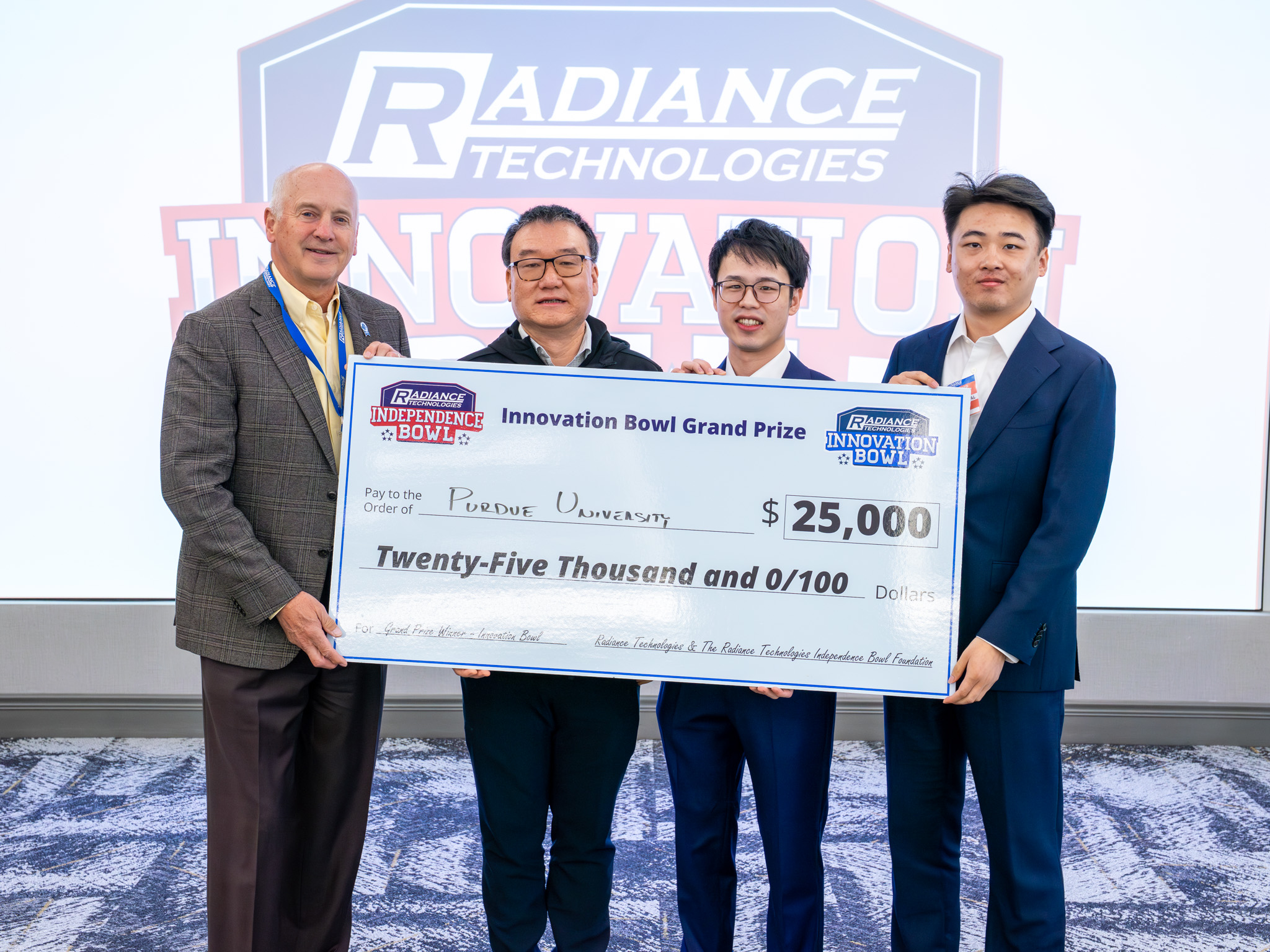
Team TruSeLLM accepting the award for earning the top prize at the 2026 Innovation Bowl. (Photo courtesy of Radiance Technology.
Team TruSeLLM from Purdue University’s Department of Computer Science earned the top prize at the 2026 Innovation Bowl with AutoVerifier, a framework designed to improve the trustworthiness of AI-generated scientific and technical analysis.
The TruSeLLM team includes Ninghui Li, who served as faculty advisor and guided the overall project direction and system design. Yuntao Du designed the system architecture and key algorithms, wrote the report, and delivered the presentation. Minh Dinh implemented the system and prepared the demonstration, while Kaiyuan Zhang contributed to system design and presentation preparation.
The team’s project, AutoVerifier, addresses what researchers describe as a growing “verification gap” in Scientific and Technical Intelligence (S&TI) analysis. While existing systems can often confirm surface-level facts, they frequently fail to validate deeper methodological claims. Large language models (LLMs) can accelerate analysis, but they are also prone to hallucinations and unsupported conclusions.
To solve this problem, the team developed an agentic LLM framework that automates the verification of complex technical claims without requiring domain expertise. AutoVerifier uses a six-layer pipeline that ingests documents, extracts key entities, and breaks technical assertions into structured “annotated claim triples” consisting of subjects, predicates, objects, and attributes. The system then verifies those claims through intra-document analysis, cross-source comparisons, and external corroboration before producing a hypothesis matrix that scores the maturity and validity of a technology.
The project was inspired by the ontology-based modeling approach used by Palantir Technologies. The team adapted that concept to technical verification by forcing the LLM to map claims as structured entities and relationships rather than relying on free-text inference. This structure helps prevent hallucinations while making it easier to identify contradictions, implicit dependencies, and the root causes of disagreements between sources.
"It has been a wonderful experience developing this project alongside such a dedicated team,” says Du. “I am excited to see the real-world potential of our framework to address critical gaps in technical verification. We are deeply honored to be named this year's Grand Prize winner, and grateful for Purdue's support.”
The competition unfolded in two phases. During Phase One, teams submitted a conceptual proposal describing their framework. In Phase Two, the Purdue team applied the framework to the quantum computing domain, using a target research paper to demonstrate the system in practice. In March 2026, three members of the team traveled to Huntsville to present their work in person. Finalists delivered a 20-minute presentation followed by a 10-minute question-and-answer session with judges.
“I’m continually impressed by the power of well-designed AI agentic systems to research and analyze information, and I’m grateful for the opportunity to participate in the Innovation Bowl hosted by Radiance Technologies,” says Li.
This year’s competition centered on validating LLM outputs for scientific analysis, reflecting growing concerns about reliability and trustworthiness as AI becomes more deeply integrated into high-stakes research and development work. The team said the topic aligned closely with their expertise in computer science and AI systems.
More information about past Innovation Bowl competitions and winners is available through Radiance Technologies Innovation Bowl.
About the Department of Computer Science at Purdue University
Founded in 1962, the Department of Computer Science was created to be an innovative base of knowledge in the emerging field of computing as the first degree-awarding program in the United States. The department continues to advance the computer science industry through research. U.S. News & World Report ranks the department No. 16 and No. 19 overall in undergraduate and graduate computer science, respectively. Graduates of the program are able to solve complex and challenging problems in many fields. Our consistent success in an ever-changing landscape is reflected in the record undergraduate enrollment, increased faculty hiring, innovative research projects, and the creation of new academic programs. Learn more at cs.purdue.edu.