Computational Science and Engineering Track
General Information
The Computational Science and Engineering track focuses on using computation to model, simulate, analyze, and optimize complex systems arising in science, engineering, and data-driven applications. This track is designed to prepare you for careers in industry and research, as well as for graduate study, in areas that rely on mathematical modeling, numerical computation, algorithms, and large-scale software systems.
Coursework and Topics
Students completing this track explore topics including:
- Ordinary differential equations and mathematical modeling
- Numerical methods and numerical linear algebra
- Algorithm design and analysis
- Optimization and operations research
- Data mining, machine learning, and bioinformatics
- Parallel, concurrent, and systems-level computing
The required coursework ensures breadth across mathematics, algorithms, and systems, while electives allow students to tailor the track toward numerical analysis, optimization, parallel computing, robotics, artificial intelligence, or theoretical foundations.
Graduate Pathways
Jobs and activities for students graduating from this track may include:
- Computational Science and Engineering Industry Roles – working on simulation software, numerical libraries, performance-critical code, and computational modeling tools.
- Data Science and Machine Learning Applications – developing algorithms and systems for data mining, bioinformatics, information retrieval, and large-scale data analysis.
- Engineering and Scientific Software Development – building and maintaining software for modeling, simulation, and analysis in areas such as aerospace, energy, materials science, and biomedical engineering.
- High-Performance and Parallel Computing – designing and optimizing parallel and distributed algorithms for multicore processors, GPUs, and large computing systems.
- Research Laboratories and National Labs – working in applied research environments focused on scientific computing, modeling, and large-scale simulation (often with a graduate degree).
- Graduate School – pursuing an MS or PhD in computer science, computational science and engineering, applied mathematics, data science, or engineering disciplines, leading to careers in research labs, industry R&D, and academia.
Courses
| Course | Title |
|---|---|
|
or |
Ordinary Differential Equations |
| CS 31400 | Numerical Methods |
| CS 38100 | Introduction to the Analysis of Algorithms |
| Applications - 1 From the Following List | |
| CS 37300 | Data Mining and Machine Learning |
| CS 47300 | Web Information Search and Management |
| CS 47800 | Introduction to Bioinformatics |
| IE 33600 | Operations Research - Stochastic Models |
| ECE 30100 | Signals and Systems |
| Systems - 1 From the Following List | |
| CS 35200 | Compilers: Principles and Practice |
| CS 35300 | Principles of Concurrency and Parallelism |
| CS 35400 | Operating Systems |
Note: Any course beyond the one required class from the list of Applications/Systems courses also counts as an elective.
| Course | Title |
|---|---|
| CS 30700 | Software Engineering I |
| CS 42200 | Computer Networks |
| CS 45600 | Programming Languages |
| CS 45800 | Introduction to Robotics |
| CS 47100 | Introduction to Artificial Intelligence |
| CS 48300 | Introduction to the Theory of Computation |
| CS 51400 | Numerical Analysis |
| CS 51500 | Numerical Linear Algebra |
| CS 52000 | Computational Methods In Optimization |
| CS 52500 | Parallel Computing |
| IE 33500 | Operations Research - Optimization |
| MA 34100 | Foundations of Analysis |
| MA 44000 | Honors Real Analysis I |
All major required courses, all track requirements and track selectives, and their pre-requisites, regardless of department, must be completed with a grade of C or better.
Notes:
- At least four (4) of the seven (7) classes for this track must be CS classes.
- No course can be counted both for required and elective credit. This is true for all tracks.
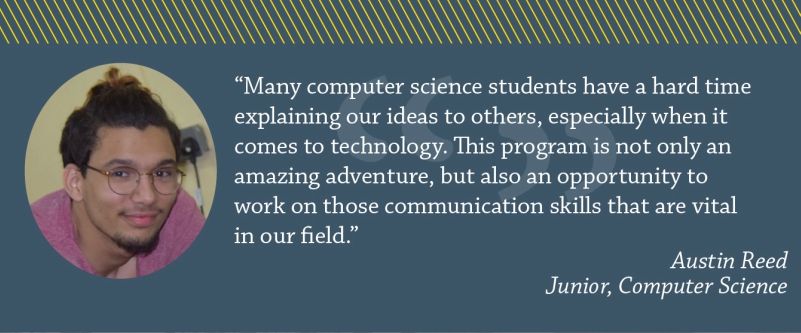
Student Testimonial