Kate earns 2025 IACR Test-of-Time Award
02-11-2026
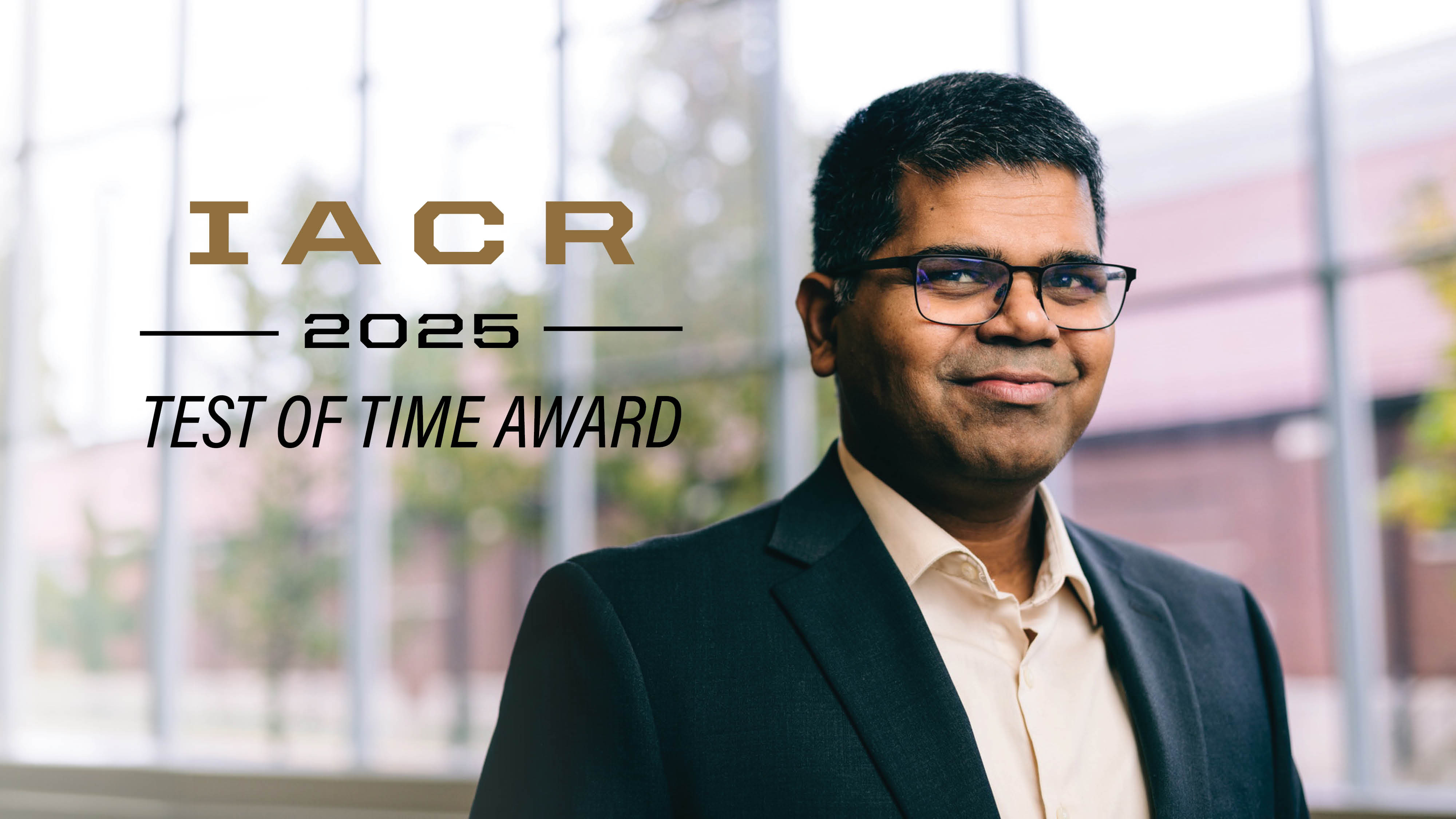
Associate Professor of Computer Science, Aniket Kate (photo courtesy of Brian Powell)
“Pick a card, any card.” If you have ever seen a magician in action, you are probably familiar with the phrase. Watching a magician reveal your chosen card is a classic crowd-pleaser, but what if the magician could reveal a single card from a sealed deck, leaving the rest untouched?
That question reflects a real challenge in cryptography explored in award-winning research co-authored by Purdue University’s Associate Professor of Computer Science, Aniket Kate, Professor at the Cheriton School of Computer Science at University of Waterloo, Ian Goldberg and Microsoft Research Security and Cryptography Group Software Engineer, Gregory Zaverucha.
Their 2010 paper titled “Constant-Size Commitments to Polynomials and Their Applications” is being recognized with the 2025 International Association for Cryptologic Research (IACR) Test-of-Time Award. The award honors papers that have demonstrated exceptional and lasting impact on the field of cryptography, in this case, 15 years after publication.
“This is a rare honor because it recognizes not just the novelty of the work at the time, but how much it shaped what came after,” Kate said. “It is rewarding to see the ideas from this paper become a practical building block for real systems used at a global scale.”
Since its publication, the work has become foundational to modern cryptographic systems used in zero-knowledge proof systems, blockchain infrastructure, and secure verification.
The breakthrough
In cryptography, a commitment works like a sealed envelope. Someone can lock in a secret message so it cannot be changed, while keeping it hidden until the time comes to reveal it. Commitments are essential tools for building systems that require both privacy and verification.
 The challenge is scale. When users need to commit to many pieces of private information, such as a long list of values, traditional cryptographic methods often require the commitment to grow larger as the data grows.
Kate and his co-authors introduced a new approach: polynomial commitments, a method that allows a large list of messages to be represented as a single polynomial and committed to in one compact object. The breakthrough is that individual elements of that list can later be revealed or proven correct using a short proof, without exposing everything else. The resulting construction is now widely known as the KZG commitments, named after its authors: Kate, Zaverucha, and Goldberg.
Real-world impact
Over time, the KZG commitment scheme became a major building block for cryptographic protocols that require efficient verification with minimal communication. Its ability to remain constant in size, even when committing to very large datasets, has made it particularly valuable in emerging technologies where speed and scalability are essential.
Today, KZG commitments are used across applications, including zero-knowledge proof systems, multi-party computation, and verifiable distributed storage. They have also become prominent in blockchain ecosystems, including the Ethereum network, as well as data availability and scaling solutions such as EigenCloud, Avail, and Scroll.
Kate noted that the award is especially meaningful because it reflects how widely the work has been adopted beyond academia.
“When we wrote this paper, we were thinking about improving cryptographic efficiency and communication costs,” he said. “It’s exciting to see these ideas play such a central role in systems that millions of people depend on today.”
Kate was the primary contributing author of the paper, which was part of his doctoral thesis work. The research was conducted at the University of Waterloo and co-authored with his PhD advisor, Ian Goldberg, now a professor at Waterloo, and fellow graduate student Gregory Zaverucha, now with Microsoft Research.
Kate is currently an associate professor in Purdue’s Department of Computer Science and is affiliated with the Center for Education and Research in Information Assurance and Security (CERIAS).
ASIACRYPT Test-of-Time Award
The ASIACRYPT Test-of-Time Award is presented annually to papers that have stood out for their influence on cryptography research and practice long after their original publication. Unlike many research awards that focus on immediate impact, this honor highlights work that continues to shape the field years later.
For Kate, the award represents more than recognition of a single paper; it reflects the enduring value of building strong foundations in cryptography.
“Some ideas take time to reach the world,” he said. “This award is a reminder that foundational research can become infrastructure.”
The breakthrough behind KZG commitments is not unlike the magician’s sealed deck: the ability to reveal exactly what is needed, without disturbing what must remain private. Fifteen years after its publication, Kate’s research continues to power systems that rely on the same principle, proving trust, without giving everything away.
About the Department of Computer Science at Purdue University
Founded in 1962, the Department of Computer Science was created to be an innovative base of knowledge in the emerging field of computing as the first degree-awarding program in the United States. The department continues to advance the computer science industry through research. U.S. News & World Report ranks the department No. 16 and No. 19 overall in undergraduate and graduate computer science, respectively. Graduates of the program are able to solve complex and challenging problems in many fields. Our consistent success in an ever-changing landscape is reflected in the record undergraduate enrollment, increased faculty hiring, innovative research projects, and the creation of new academic programs. Learn more at cs.purdue.edu.