[Research] [Teaching] [Publications] [Grants] [Students]
|
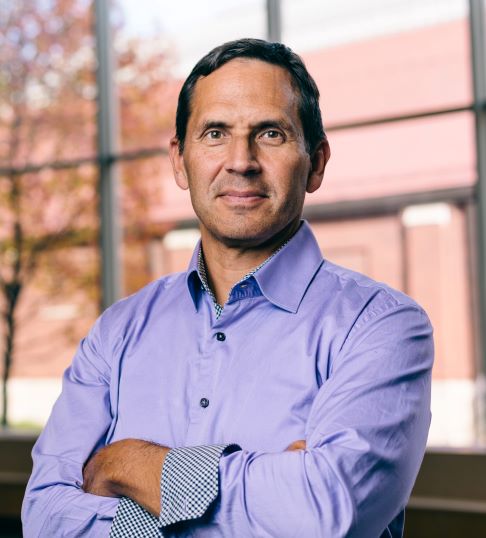
Daniel G. AliagaProfessor of Computer Science, Purdue UniversityDirector of URBX LabEducation: Daniel Aliaga holds BS in Computer Science, honors thesis (with Andy van Dam) and magna cum laude, from Brown University. Subsequently, obtained a MS (with Henry Fuchs) and a PhD degree (with Anselmo Lastra, Fred Brooks, and Dinesh Manocha) in Computer Science from UNC Chapel Hill. Worked at Nokia/Lucent/AT&T Bell Labs (with Ingrid Carlbom) and at Princeton University as a researcher (with Tom Funkhouser). He now leads the URBX Lab at Purdue University. Dr. Aliaga has held visiting professor positions at ETH Zurich Information Architecture and also ETH Computer Science, INRIA Sophia-Antipolis, and KAUST in Saudi Arabia. After finishing high school (Colegio Santa Maria), Daniel immigrated from Lima, Peru and is the first in his family and relatives to hold a PhD. Products: Dr. Aliaga's first computer graphics publication was in 1991 and he now has over 170 refereed publications covering multiple disciplines, holds membership in 90+ program committees, has on-going international multi-disciplinary collaborations (i.e., with computer science, urban planning, architecture, meteorology, atmospheric/earth sciences, engineering, archaeology, forestry, and more), and has given over 50 invited talks (in the US, Brasil, Colombia, Ecuador, France, Japan, Korea, Peru, Qatar, Sweden, and Switzerland; TEDx). Further, Dr. Aliaga has been technical advisor on multiple startups (Synthicity, UrbanSim, Authentise). Funding: Prof. Aliaga has obtained 30 external peer-reviewed grants totaling $45M (and is PI on 22 of them). Funding sources include NSF, IARPA, USDA, Internet2, MTC, Google, Microsoft, and Adobe. Service and Awards: Daniel is Associate Editor for IEEE TVCG and for Visual Computing Journal (previously for Computer Graphics Forum and Graphical Models) and PC member for SIGGRAPH, CVPR, ICCV, Eurographics, AAAI, I3D, IEEE Vis. He has received a Fulbright Scholar Award, a Discovery Park Faculty Research Fellowship, and his PhD advisees have received a total of 11 Purdue fellowships/grants. He is a member of ACM SIGGRAPH and ACM SIGGRAPH Pioneers, and has multiple times been Chair of Faculty Diversity for College of Science at Purdue. |
Contact:
|
Lawson Computer Science Building, Rm 3177 305 N. University St, West Lafayette, IN 47907-2107 |
Phone: 765-494-6010 (main office) FAX: 765-494-0739 Email: aliaga at cs dot purdue dot edu |
Teaching
|
Dr. Aliaga pursues visual computing for modeling and improving the complex urban ecosystem. His work develops semi-automatic and automatic algorithms for controllable content creation and edition of large and complex geometric models for use in urban digital twins, simulation, visualization, entertainment, education, and cultural heritage. His methodologies generally convert incomplete and unstructured data into organized and easily editable procedural representations. While a significant benefit of procedural modeling is its detail amplification, it is very difficult to develop a compact, expressive, and editable set of procedural rules. His research group has innovated various forms of generative modeling, urban artificial intelligence, and optimization to infer procedural rules and parameter, graphs and layouts, 3D models, images, sketches, point clouds, roads, facades, buildings, cities, and vegetation. In addition, he has developed multiple novel image processing, 3D reconstruction methods, 3D spatial augmented reality, camera calibration, and computational display solutions. Further, Dr. Aliaga leads and participates in numerous computational urban projects in city gray and green planning, atmospheric/geological sciences, civil engineering, architecture, and transportation engineering to capture, simulate, and modify models of current and future urban environments. |
Selected Publications
ShellMaker: Language-Guided Exterior Completion under Structural Constraints.
R. Xu, D. Aliaga, European Conference on Computer Vision (ECCV), September 2026Urbane: Urban Reasoning And Block Adjustment Via Natural-Language Editing.
T. Waltz, J. Vera, D. Aliaga, International Conference on Pattern Recognition (ICPR), August 2026AI-based urban layout generation model.
L. He, H. Kamath, S. Fei, D. Niyogi, D. Aliaga, Nature, Urban Sustainability, April 2026Where are the City Trees: Monitoring Urban Trees across the U.S. using Generative AI.
A. Firoze, A. Uppala, R. Yeh, B. Benes, L. Darling, B. Hardiman, S. Fei, D. Aliaga, Communications of the ACM (CACM), April 2026Building Instance Segmentation for Dense Urban Settlements.
A. Firoze, R. Yeh, D. Aliaga, AAAI Conference on Artificial Intelligence, January 2026MMIG-Bench: Towards Comprehensive and Explainable Evaluation of Multi-Modal Image Generation Models.
H. Hua, Z. Zeng, Y. Song2, Y. Tang, L. He, D. Aliaga, W. Xiong, J. Luo, Neural Information Processing Systems (NeurIPS), 2025Self-Supervised Large Scale Point Cloud Completion for Archaeological Site Restoration.
A. Li, J. Zimmer-Dauphinee, R. Kalyanam, I. Lindsay, P VanValkenburgh, S. Wernker, D. Aliaga, IEEE Computer Vision and Pattern Recognition (CVPR), 2025Kubrick: Multimodal Agent Collaborations for Synthetic Video Generation.
L. He, Y. Song, H. Huang, P. Liu, Y. Tang, D. Aliaga, X. Zhou, IEEE Computer Vision and Pattern Recognition (CVPR), Workshop: AI for Content Creation, 2025Refine-by-Align: Reference-Guided Artifacts Refinement Through Semantic Alignment.
Y. Song, L. He, Z. Zhang, S. Kim, H. Zhang, W. Xiong, Z. Lin, B. Price, S. Cohen, J. Zhang, D. Aliaga, International Conference on Learning Representations (ICLR), 2025COHO: Context-Sensitive City-Scale Hierarchical Urban Layout Generation.
L. He, D. Aliaga, European Conference on Computer Vision (ECCV), 2024EpipolarGAN: Omnidirectional Image Synthesis with Explicit Camera Control.
C. May, D. Aliaga, European Conference on Computer Vision (ECCV), 2024IMPRINT: Generative Object Compositing by Learning Identity-Preserving Representation.
Y. Song, Z. Zhang, Z. Lin, S. Cohen, B. Price, J. Zhang, S. Kim, H. Zhang, D. Aliaga, IEEE Computer Vision and Pattern Recognition (CVPR), 2024Digitizing Cities for urban weather: representing realistic cities for weather and climate simulations using computer graphics and artificial intelligence .
D. Aliaga, D. Niyogi, Computational Urban Science, 2024GLObal Building heights for Urban Studies (UT-GLOBUS) for city- and street-scale urban simulations: Development and first applications.
H. Kamath, M. Singh, N. Malviya, A. Martilli, L. He, D. Aliaga, C. He, F. Chen, L. Magruder, Z.L. Yang, D. Niyogi, Nature Scientific Data, 2024GlobalMapper: Arbitrary-Shaped Urban Layout Generation.
L. He, D. Aliaga, IEEE Int'l Conference on Computer Vision (ICCV), 2023Tree Instance Segmentation with Temporal Contour Graph.
A. Firoze, C. Wingren, R. Yeh, B. Benes, D. Aliaga, IEEE Computer Vision and Pattern Recognition (CVPR), 2023ObjectStitch: Generative Object Compositing.
Y. Song, Z. Zhang, Z. Lin, S. Cohen, B. Price, J. Zhang, D. Aliaga, IEEE Computer Vision and Pattern Recognition (CVPR), 2023Deep Learning based Urban Morphology for City-scale Environmental Modeling.
P. Patel, R. Kalyanam, L. He, D. Aliaga, D. Niyogi. Proceedings of the National Academy of Sciences (PNAS) Nexus, 2023Generative Building Feature Estimation from Satellite Images.
L. He, J. Shan, D. Aliaga, IEEE Transactions on Geoscience and Remote Sensing (TGRS), 2023CubeGAN: Omnidirectional Image Synthesis Using Generative Adversarial Networks.
C. May, D. Aliaga, Computer Graphics Forum (CGF), Eurographics, 2023Modeling Large-Scale Heatwave by Incorporating Enhanced Urban Representation.
P. Patel, S. Jamshidi, R. Nadimpalli, D. Aliaga, G. Mills, F. Chen, M. Demuzere, D. Niyogi. Journal of Geophysical Research: Atmospheres, 2022Procedural Roof Generation From a Single Satellite Image.
X. Zhang, D. Aliaga. Computer Graphics Forum (CGF), Eurographics, 2022Impact of green roofs on heavy rainfall in tropical, coastal urban area.
P. Patel, S. Karmakar, S. Ghosh, D. Aliaga, D. Niyogi. Environmental Research Letters (ERL), 2021.Automatic Deep Inference of Procedural Cities from Global-Scale Spatial Data.
X. Zhang, A. Shehata, B. Benes, D. Aliaga. ACM Transactions on Spatial Algorithms and Systems, 2021Synthesis and Completion of Facades from Satellite Imagery.
X. Zhang, C. May, D. Aliaga. European Conference on Computer Vision (ECCV), 2020Design and Deployment of Photo2Building: A Cloud-based Procedural Modeling Tool as a Service.
M. Bhatt, R. Kalyanam, G. Nishida, L. He, C. May, D. Niyogi, D. Aliaga, Practice and Experience in Advanced Research Computing (PEARC), 2020Pathway using WUDAPT's Digital Synthetic City tool towards generating urban canopy parameters for multi-scale urban atmospheric modeling.
J. Ching, D. Aliaga, G. Mills, V. Masson, L. See, M. Neophytou, A. Middel, A. Baklanov, C. Ren, E. Ng, J. Fung, M. Wong, Y. Huang, A. Martilli, O. Brousse, I. Stewart, X. Zhang, A. Shehata, D. Niyogi, Urban Climate, 2019Urban Walkability Design using Virtual Population Simulation.
T. Mathew, P. Knob, S. Musse, D. Aliaga, Computer Graphics Forum (CGF), 2019Procedural Modeling of a Building from a Single Image.
G. Nishida, A. Bousseau, D. Aliaga, Computer Graphics Forum (CGF), Eurographics, 2018Procedural Generation of Flood-Sensitive Urban Layouts.
A. Mustafa, X. Zhang, G. Nishida, M. Bruwier, B. Dewals, J. Teller, D. Aliaga, Environment and Planning B: Urban Analytics and City Science, 2018Fast Weather Simulation for Inverse Procedural Design of 3D Urban Models.
I. Garcia-Dorado, D. Aliaga, P. Bhalachandran, P. Schmid, D. Niyogi, ACM Transactions on Graphics (TOG), 2017Interactive Sketching of Urban Procedural Models,
G. Nishida, I. Garcia-Dorado, D. Aliaga, B. Benes, A. Bousseau. ACM Transactions on Graphics (TOG), 2016Coupled Segmentation and Similarity Detection for Architectural Models.
I. Demir, D. Aliaga, B. Benes. ACM Transactions on Graphics (TOG), 2015Procedural Editing of Building Point Clouds.
I. Demir, D. Aliaga, B. Benes, IEEE Int'l Conference on Computer Vision (ICCV), 2015A Total Variation Approach for Customizing Imagery to Improve Visual Acuity.
C. Montalto, I. Garcia-Dorado, D. Aliaga, M. Oliveira, F. Meng. ACM Transactions on Graphics (TOG), 2015Designing Large-Scale Interactive Traffic Animations for Urban Modeling.
I. Garcia-Dorado, D. Aliaga, S. Ukkusuri, Computer Graphics Forum (CGF), Eurographics, 2014Visualization-based Decision Tool for Urban Meteorological Modeling.
D. Aliaga, C. Vanegas, M. Lei, D. Niyogi. Environment and Planning B: Planning and Design, 2013Inverse Design of Urban Procedural Models.
C. Vanegas, I. Garcia-Dorado, D. Aliaga, B. Benes, P. Waddell. ACM Transactions on Graphics (TOG), 2012Fast High-Resolution Appearance Editing Using Superimposed Projections.
D. Aliaga, Y. H. Yeung, A. Law, B. Sajadi, A. Majumder. ACM Transactions on Graphics (TOG), 2012Tailored Displays to Compensate for Visual Aberrations.
V. Pamplona, M. Oliveira, D. Aliaga, R. Raskar. ACM Transactions on Graphics (TOG), 2012Pose-Free Structure from Motion Using Depth From Motion Constraints.
J. Zhang, M. Boutin, D. Aliaga, IEEE Transactions on Image Processing (TIP), 2011Building Reconstruction using Manhattan-World Grammars.
C. Vanegas, D. Aliaga, B. Benes. IEEE Computer Vision and Pattern Recognition (CVPR), 2010A Self-Calibrating Method for Photogeometric Acquisition of 3D Objects.
D. Aliaga, Y. Xu. IEEE Transactions on Pattern Analysis and Machine Intelligence (PAMI), 2010High-Resolution Modeling of Moving and Deforming Objects Using Sparse Geometric and Dense Photometric Measurements.
Y. Xu, D. Aliaga, IEEE Computer Vision and Pattern Recognition (CVPR), 2010
All Publications
Grants








Students
Graduate Students (advisees)