Creative writing · Satire
Rogue’s Rebuttal to the Fluorescent Crown
Being a Defense of Variety, Rubber Vegetables, and the Week Without Felt

I have heard Kali’s defense of the tennis ball. Everyone has heard Kali’s defense of the tennis ball. It is delivered daily, without invitation, through fixed staring, theatrical sighing, and the repeated placement of one damp fluorescent sphere upon the lap or between the knees of innocent people.
She has now committed the argument to prose, which is unfortunate. A private obsession can be managed. Once furnished with a title, an ancestral mythology, and several references to civilization, it begins to resemble a political movement.
Her thesis, beneath all the ceremonial language, is simple: the tennis ball represents the culmination of play, the frisbee survives as a respectable but subordinate ally, and every other toy is a vulgar deviation from the natural order. Kali does not merely prefer the tennis ball. She has appointed it sovereign, declared its privileges hereditary, and dismissed the remainder of the toy box as a disorderly collection of pretenders.
This is what happens when a personal fixation acquires a vocabulary.
I, too, am a border collie. I possess the same intelligence, athleticism, vigilance, and capacity to monitor every human movement in the house without appearing to move at all. Yet I have never concluded that these gifts require lifelong submission to one yellow-green sphere. The world contains balls, bones, rings, ropes, discs, squeakers, rubber vegetables, and several soft creatures whose designers plainly abandoned the question of species halfway through production. To reject such abundance in favor of one regulation object is not refinement. It is provincialism with excellent publicity.
My own principle is simpler:
Throw it.
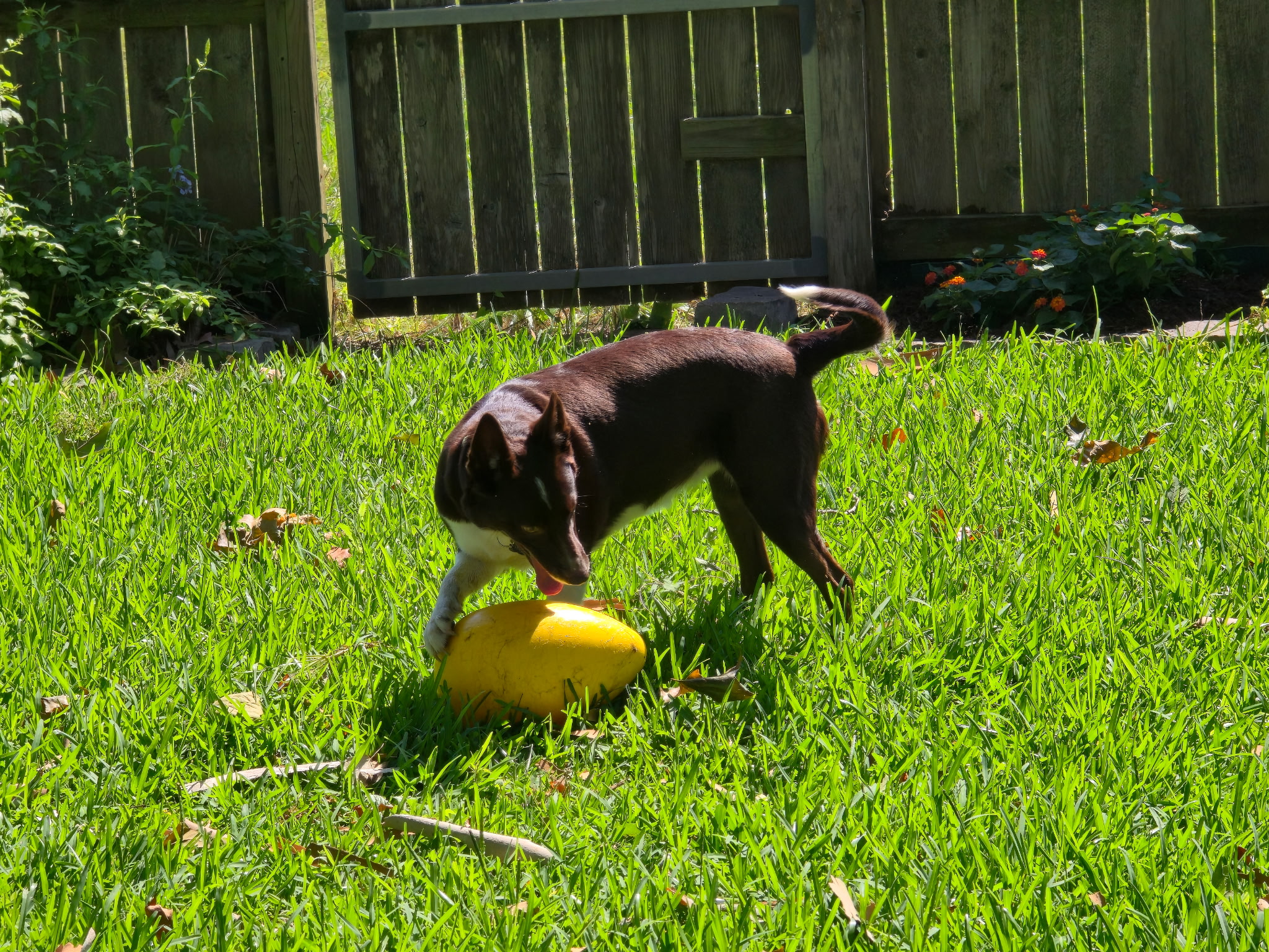
A toy lying motionless on the floor has not yet made its case. Its character emerges in flight. How does it leave the hand? How does it strike the earth? Does it rebound cleanly, skid sideways, disappear under a chair, or veer inexplicably toward a flowerpot?
Kali conducts her judgments from the carpet, like an elderly critic dismissing a new school of painting without entering the gallery. I prefer direct experience.
I retrieve first. I pronounce afterward.
This does not mean I lack standards. My enthusiasms are exacting, intense, and gloriously provisional. I may spend an afternoon carrying one object from room to room as though entrusted with a minor relic, then pass it the following morning without acknowledgment. Humans call this fickleness, although humans will eat the same breakfast for twelve years and consider themselves adventurous because they changed brands of coffee.
Taste is not a monument. It is alive, responsive, and occasionally distracted by something blue.
At present, I am particularly devoted to the rubber corn on the cob.
Kali regards this as an embarrassment, which is unsurprising, since Kali regards nearly everything not covered in fluorescent felt as an embarrassment. The corn, however, possesses virtues her sacred sphere cannot approach. It is semantically food, materially toy, and aerodynamically answerable to no recognized authority. It travels through the air with the grave confidence of a ceremonial vegetable flung during a constitutional crisis.
Its landing is even better. A tennis ball bounces in the obedient fashion expected of it. The corn may roll, pivot, leap sideways, or stop abruptly, as though interrupted by a sudden philosophical objection. No two pursuits are quite alike. The object does not merely permit retrieval; it contributes to the occasion.
Kali chases predictability.
I chase the corn.
Then there is the blue-and-white spiky bone, an object of such tactile and architectural ambition that calling it a toy seems almost reductive. Its bone shape acknowledges the ancient traditions of doghood, while its synthetic rubber announces modernity. Its colors are dignified. Its spikes invite sustained consideration by the teeth. Its weight gives every landing the satisfying finality of a serious book being closed.
It may be chased, carried, gnawed, displayed, or deposited directly into a human lap as formal notice that recreation has been delayed beyond reason. It is ancestral and industrial, practical and ceremonial, dignified and faintly absurd.
It is a cathedral of chew.
Kali mistakes this versatility for vulgarity because her imagination has been disciplined by the tennis ball’s narrow competence. The tennis ball flies well. It bounces well. It fits comfortably in the mouth. These are respectable achievements, but they hardly justify absolute rule. A spoon performs its function admirably; no one therefore insists that every meal consist entirely of spoons.
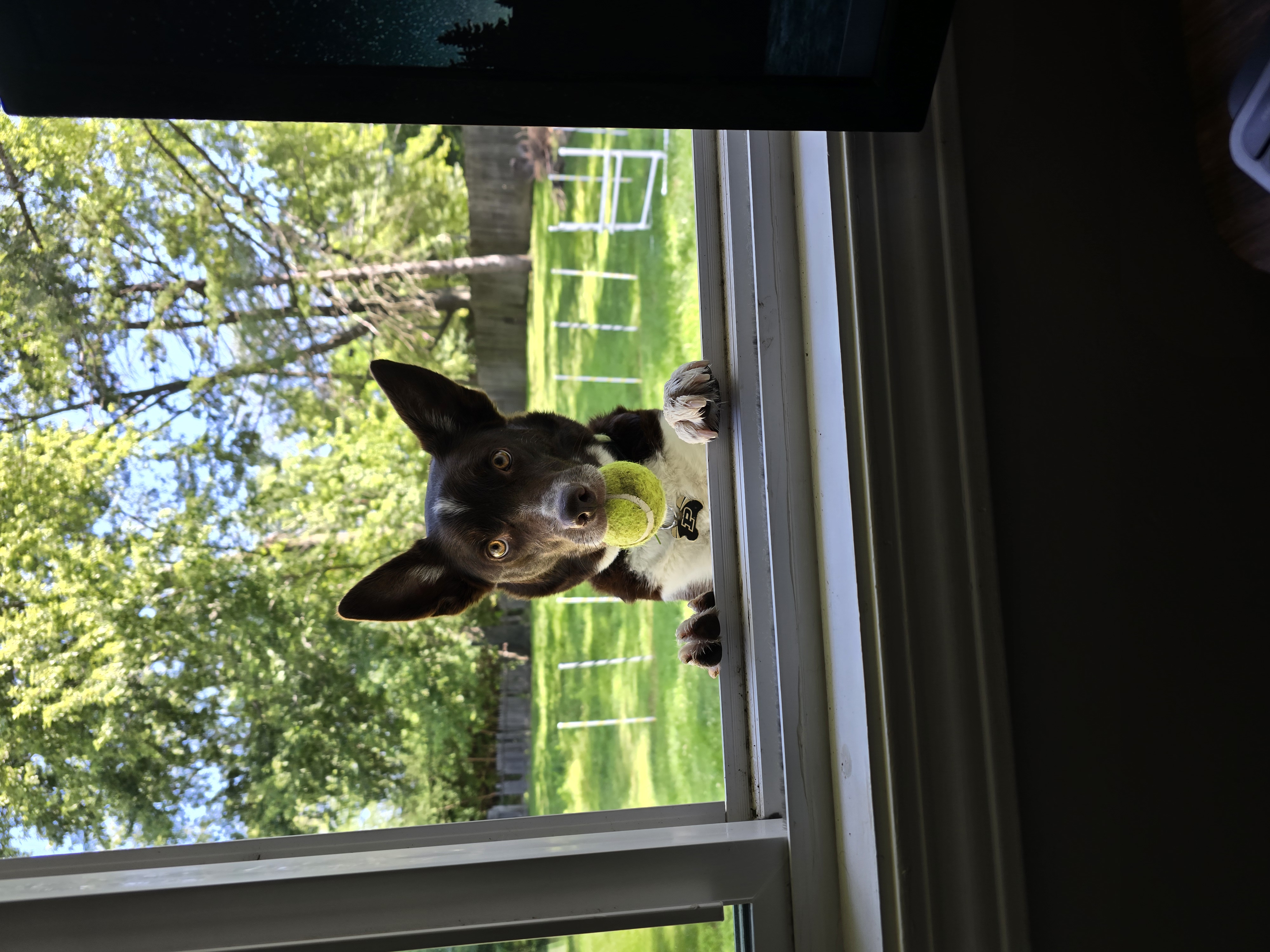
To be clear, I bear no hostility toward the tennis ball itself. When one is thrown and I happen to be interested, I retrieve it with distinction. My objection is constitutional.
The tennis ball should be a citizen of the toy box, not its monarch.
Fortunately, our household has developed a corrective institution. At rare intervals, when Kali’s enthusiasm has hardened into organized religion, the humans declare what is known as a tennis-ball cleanse. Every tennis ball disappears for one full week. Closets close. Shelves empty. The familiar yellow-green order vanishes overnight.
Thus begins the Week Without Felt.
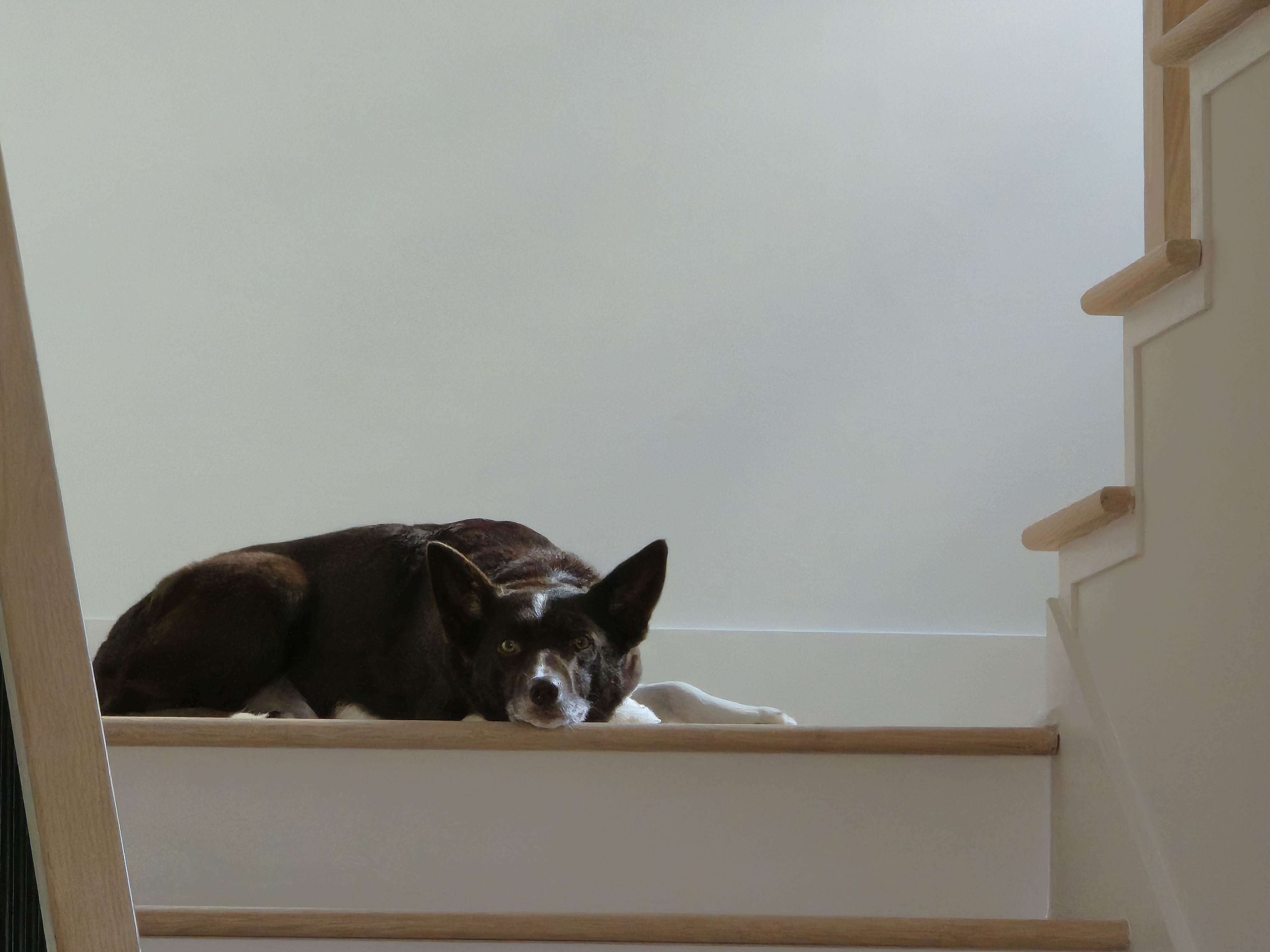
At first, Kali assumes an administrative error has occurred. She approaches the usual basket, discovers no ball, and checks again, apparently on the theory that reality may have been briefly mistaken. She searches beneath the couch, behind the chairs, beside the door, and in several locations where no tennis ball has ever existed. The investigation gradually takes on the solemnity of an inquiry into missing crown jewels.
Then comes the accusation.
She looks at the humans. She looks at the empty basket. She looks back at the humans with the expression of a duchess informed that the estate has been nationalized.
For the next day or two, she regards the available toys as artifacts recovered from a civilization too primitive to deserve written history. Rubber balls are beneath notice. Rope toys are treated as debris. Plush animals receive the cold stare ordinarily reserved for betrayal by trusted advisers.
Kali calls this principled resistance.
I call it antitrust enforcement.
The cleanse is designed to remind her that play existed before the monopoly and may continue after it. For several days, Kali persists in her principled despair. Yet eventually, confronted with the intolerable prospect of continued inactivity, she will engage with another toy. Perhaps a rubber ball. Perhaps a rope. Perhaps something she previously condemned as an affront to breeding, dignity, and the accumulated wisdom of the border country.
She retrieves it.
Then she retrieves it again.
By the end of the week, she has demonstrated the very adaptability her manifesto denies.
Not joyfully enough to admit error, naturally. Kali does not revise a position. She merely behaves in a manner temporarily inconsistent with it. Still, the evidence is before us. Beneath the doctrine, the sighing, and the great edifice of tennis-ball exceptionalism remains an ordinary dog fully capable of enjoying something else.
The humans call the cleanse retraining.
I call it the peaceful restoration of constitutional government.
My argument is not that every toy is equal. Some toys are excellent. Some are mediocre. Some emit a squeak so piercing that one briefly understands Kali’s concern for civilization. Nor do I claim that today’s favorite must remain tomorrow’s. Today may belong to the corn. Tomorrow may favor the spiky bone. By Friday, an object ignored since February may suddenly become indispensable.

The toy box is not a hierarchy fixed for all time. It is a salon, a republic, a cabinet of curiosities, and occasionally a scene of violent rubber agriculture. Its treasures need not resemble one another. They need only pass the essential test: a human takes one in hand, I lean forward, the room becomes charged with possibility, and the toy flies because, for one brief and excellent moment, we have agreed that it should.
Kali may keep her fluorescent crown. She may compose further treatises on its purity, lineage, and rightful place at the summit of creation. She may lie beside it in aristocratic sorrow whenever no one agrees to throw it.
The question is not which toy deserves eternity.
The question is why you are still holding that one.
Throw it.