Computational Vegetation Lab at Purdue University
Computational Vegetation Lab focuses on digital twins of plants, particularly on digital tree models. We research the shape, structure, and function of vegetation. We study the plant’s shape, development over time, and interaction with its environment (light, water, wind, temperature). Most of the work has been done in collaboration with our colleagues and past members, listed on the Members page.
News
Jun 2026Woodstock Interactive Modeling of Fungal Wood Decay paper accepted to Siggraph and published in ACM Transactions on Graphics.
Jun 2026Loops-to-Roofs paper published in ACM Transactions on Graphics.
Jun 2026A-Occ-Plant Plant occluded point cloud completion via amodal segmentation published in Plant Phenomics.
Jun 2026FloraForge Procedural generation of editable and analysis-ready 3D plant geometric models using LLM-assisted template design published in Smart Agricultural Technology.
May 2026I was renewed as AE of In Silico Plants.
April 2026Zhiquan Wang successfully defended his Ph.D. thesis.
March 2026New paper at AAAI.
September 2025New NSF grant received ($0.9M).
April 2025Bosheng Li and Xiaochen Zhou successfully defended their Ph.D. theses!
... see all News
Research areas
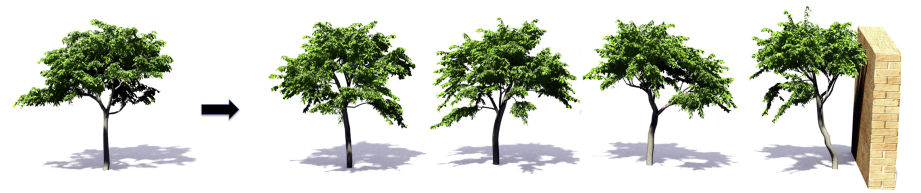 3D ReconstructionAI-based reconstruction of trees from photographs, point clouds, and inverse procedural models — recovering a digital twin that can be regrown.
Crops in SilicoMultiscale models of crops, 3D reconstruction for phenotyping, and linking genetic traits to plant architecture.
3D ReconstructionAI-based reconstruction of trees from photographs, point clouds, and inverse procedural models — recovering a digital twin that can be regrown.
Crops in SilicoMultiscale models of crops, 3D reconstruction for phenotyping, and linking genetic traits to plant architecture.
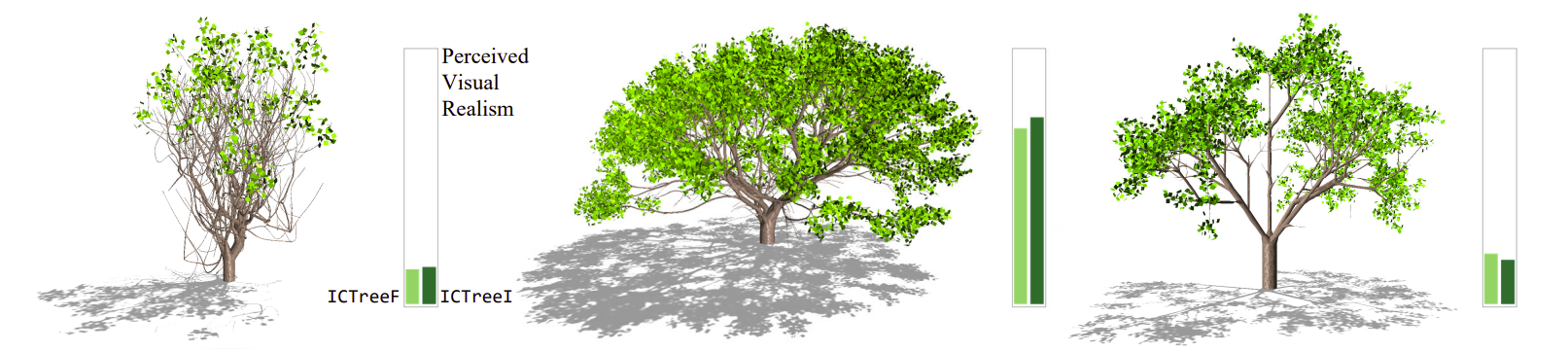 Deep Neural ModelsEncoding tree structure and behavior as deep neural models — a latent space for generating novel trees and reconstructing real ones.
 Simulation & PhysicsDevelopmental models and the physics of vegetation — response to wind, climbing plants, and environmentally adaptive "plastic" trees.
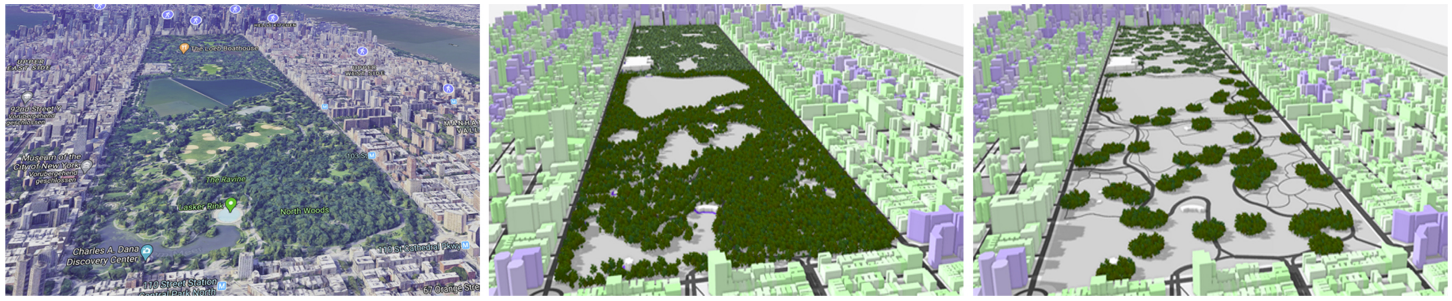 Ecosystems & Urban ForestsAuthoring whole landscapes, simulating ecosystems, and locating trees in urban environments as a special kind of ecosystem.
Orchards & IMAppleSource–sink developmental models of apple trees and automatic pruning optimization to maximize light intake.
ValidationICTree — the first perceptual model for assessing the realism of tree models, trained on a million user evaluations.
Ecosystems & Urban ForestsAuthoring whole landscapes, simulating ecosystems, and locating trees in urban environments as a special kind of ecosystem.
Orchards & IMAppleSource–sink developmental models of apple trees and automatic pruning optimization to maximize light intake.
ValidationICTree — the first perceptual model for assessing the realism of tree models, trained on a million user evaluations.