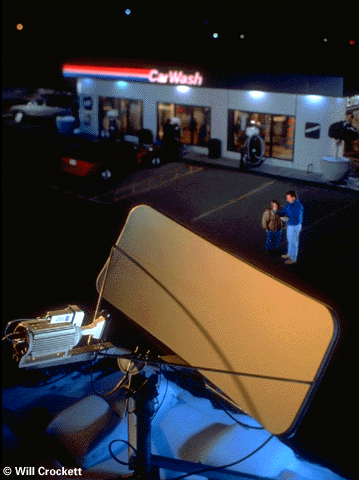
 The
Amoco
Retail Systems Technology Architecture (ARSTA) satellite is shown
on page 237 in the textbook.
The
Amoco
Retail Systems Technology Architecture (ARSTA) satellite is shown
on page 237 in the textbook.

Telecommunications
Information superhighway
Telecommunications system
Protocol
Analog signal
Digital signal
Modem
Channels
Twisted wire
Coaxial cable
Fiber-optic cable
Microwave
Satellite
Low-orbit satellites
Paging systems
Cellular telephone
Mobile data networks
Personal communication services (PCS)
Personal digital assistants (PDA)
Baud
Bandwidth
Asynchronous transmission
Synchronous transmission
Simplex transmission
Half-duplex transmission
Full-duplex transmission
Communications processors
Front-end processor
Concentrator
Controller
Multiplexer
Telecommunications software
Topology
Star network
Bus network
Ring network
Private branch exchange (PBX)
Local-area network (LAN)
File server
Network operating system
Gateway
Baseband
Broadband
Wide-area network (WAN)
Switched lines
Dedicated lines
Value-added network (VAN)
Packet switching
Frame relay
Asynchronous transfer mode (ATM)
Electronic mail (e-mail)
Voice mail
Facsimile (FAX)
Intelligent agent
Teleconferencing
Dataconferencing
Videoconferencing
Electronic data interchange (EDI)
Groupware
8.1 The Telecommunications Revolution
The Marriage of Computers and Communications
The Information Superhighway
8.2 Components and Functions of a Telecommunications System
Telecommunications System Components
Types of Signals: Analog and Digital
Characteristics of Communications Channels
Communications Processors
Telecommunications Software
8.3 Types of Telecommunications Networks
Network Topologies
Private Branch Exchanges and Local-Area Networks (LANs)
Wide-Area Networks (WANs)
Value-Added Networks (VANs)
8.4 How Organizations Use Telecommunications for Competitive Advantage
Facilitating Applications
Electronic Data Interchange
8.5 Management Issues and Decisions
The Telecommunications Plan
Implementing the Plan
IndustryNet is discussed on page 229 in the textbook.
The American Venture Capital Exchange is discussed on page 230 in the textbook.
The Rite Aid Corporation is discussed on page 237 in the textbook.
The
Amoco
Retail Systems Technology Architecture (ARSTA) satellite is shown
on page 237 in the textbook.
The RAM Mobile Data Network is discussed on page 239 in the textbook.
ARDIS is discussed on page 239 in the textbook.
RadioMail is discussed on page 239 in the textbook.
The Apple Newton MessagePad is discussed on page 240 in the textbook. The MessagePad 2000 is the most powerful member of the Apple MessagePad family.
GE Information Services is discussed on page 249 in the textbook.
General Magic Intelligent Agents are discussed in the Window on Technology on page 254 in the textbook.
Panasonic's EggCamTM is a $150-250 video teleconferencing (by PC) camera and microphone.
Novell is one of the leading network providers.
Return to homepage of MGMT 680W/681W -- Management Information Systems