1.
Page 325
Problem 5
(a) use
centered formula of order O( )
)

(b) use
centered formula of order O( )
)

(c) 

2.
Page 364
Problem 3(a)
 for
for 

since 
so, 
suppose 
(1) approximate the surface area using the composite trapezoidal rule with M=10.


(2) approximate the surface area using the composite simpson rule with M=5.


3.
Page 423
Problem 6
the distance between a point ( )and a line
  is:
is:

the line is

so,

so the distance between any point (x,y) on circle and this line is:

here (x,y) also satisfy 
so that 

solve 


so 

We have 4 possible points:
(1.09756, 4.878049)
(1.09756, -4.878049)
(-1.09756, 4.878049)
(-1.09756, -4.878049)


thus, the point on the circle which is farthest from the
chord AB is (-1.09756, -4.878049)
4.
Page 440
Problem 5
(a)
(1) h=0.2



(2)h=0.1




(b) exact
solution 
(c) F.G.E


So the F.G.E behaves as expected when h is halved.
5.
Page 448
Problem 4
(a)
· h=0.2



· h=0.1




(b) exact solution 
(c) F.G.E


So the F.G.E behaves as expected when h is halved.
6.
Page 457
Problem 5
(a)


h=0.1








(b)
exact solution is 
7.
Page 471
Problem 4
(a)

· h=0.2





· h=0.1







(b) exact solution 
(c) F.G.E


So the F.G.E behaves as expected when h is halved.
8.
Page 494 Problem
8
(a) Reformulate


use substitution  , then
the differential equation becomes a system:

with 
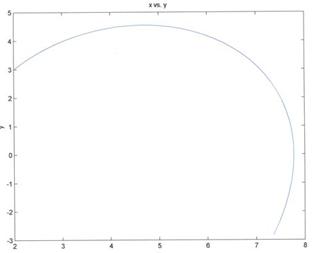
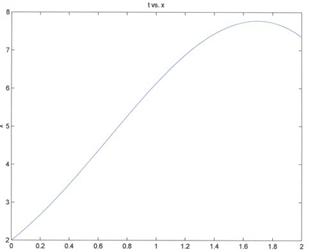
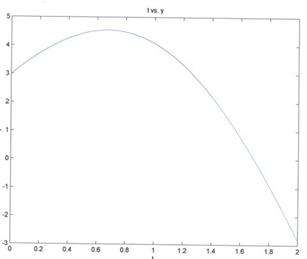
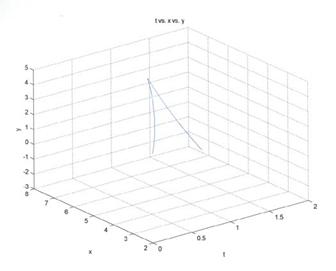
(b) Programming result:
(Courtesy of Alan
T. Saunders)
Enter the left end point of the interval: 0
Enter the right end point of the interval: 2
Enter the number of steps: 40
Input the initial value of  : 2
: 2
Input the initial value of  : 3
: 3
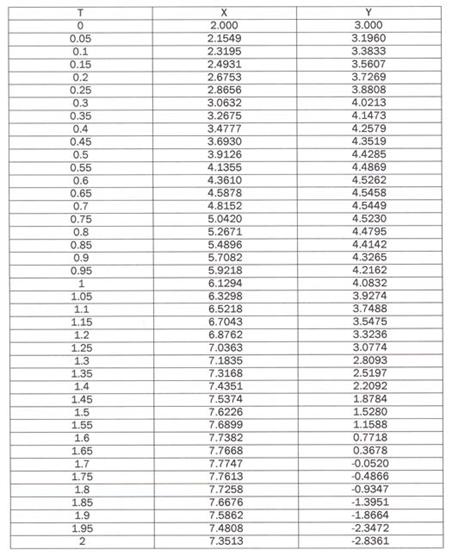
(c) (Courtesy of Alan
T. Saunders)